

Key Takeaways
PPO stands for Preferred Provider Organization. HMO stands for Health Maintenance Organization.
The acronym tells you how the network works (flexibility vs rules), not whether care is “better.”
In dental, you’ll often see DPPO vs DHMO. The idea is similar, but the day-to-day rules can feel different.
The fastest way to choose is to check dentist choice + out-of-network rules + referral/selection rules + how major services are handled.
If you’re shopping on a tight budget, the goal is simple: avoid paying cash by accident when a plan option could reduce out-of-pocket.
What Do PPO And HMO Stand For?
PPO stands for Preferred Provider Organization. A PPO has a network of doctors or dentists, and you usually pay less when you use in-network providers. Many PPO plans also let you go out of network, but that often comes with different rules and higher out-of-pocket costs.
HMO stands for Health Maintenance Organization. An HMO also has a network, but it is usually more structured. You’re typically expected to stay within the plan’s network, and some plans may require you to select a primary provider or follow specific steps to get certain types of care.
Here’s the simplest way to think about it: PPO usually gives more choice, but you have to watch the network details. HMO usually has more rules, but the path is more guided.
For example, if you want to see a provider you found online, a PPO is more likely to still allow it (with different costs and terms). An HMO is more likely to require you to choose from the plan’s network.
The letters are just the label. What matters is how that label changes your choices, your paperwork, and what you may pay.
What Changes Between PPO And HMO In Real Life?
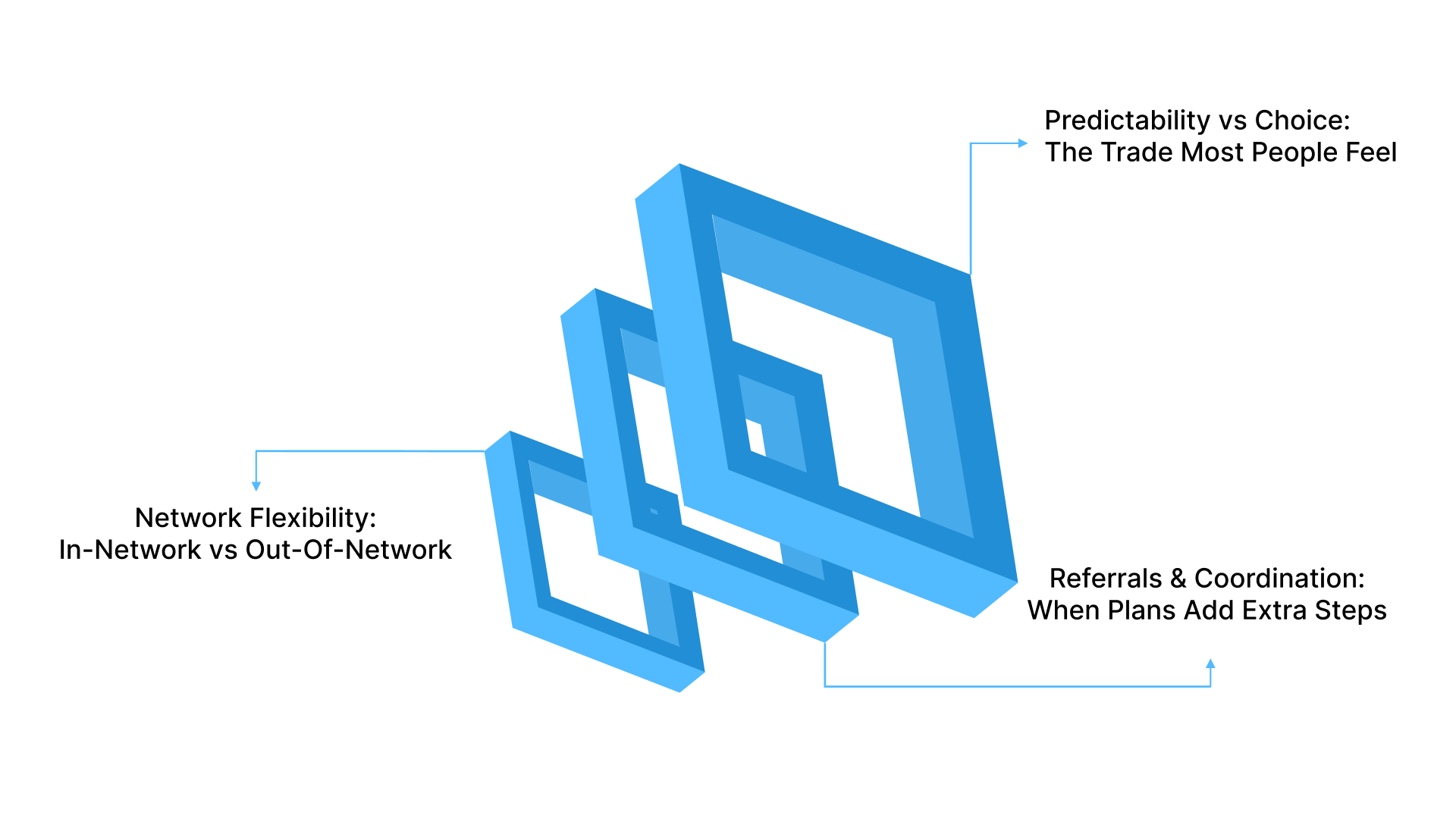
Think of PPO vs HMO as two sets of rules for three things: where you can go, how you get there, and what happens if you go outside the rules.
Network Flexibility: In-Network vs Out-Of-Network
With most plans:
PPO tends to give you more freedom to choose providers, especially inside the network, and it may still allow some out-of-network use depending on plan rules.
HMO tends to be stricter. You’re usually expected to stay inside the network, and out-of-network care may not be handled the same way (or may be limited).
Referrals and Coordination: When Plans Add Extra Steps
Some plans are structured so care flows through one main provider.
PPO-style plans often require less coordination to access different providers.
HMO-style plans often use this approach more. You may need to select a primary provider and follow the plan’s process for specialist care.
Predictability vs Choice: The Trade Most People Feel
This is the real trade:
PPO usually gives more choice, but you have to pay attention to network details so you don’t get surprised.
HMO usually gives more structure, but you may have fewer choices.
Misconception To Drop: PPO doesn’t mean “better care.”
It usually means different access rules. The quality of care depends on the provider you choose, not the plan label.
If you’re shopping for dental, the same letters show up, but the plan labels you’ll see may look slightly different.
Why This Feels Confusing
The acronyms look the same as medical insurance, but the documents you’ll read may use different language, things like “participating dentists,” “contracted rates,” or “allowed amount.” That makes two plans with the same label feel very different in real life.
PPO Vs HMO: The Fastest Way To Decide
If you’re deciding between PPO and HMO, start with how you actually use care. You need to avoid picking a plan that looks fine on paper but feels frustrating the moment you book an appointment.
How to use this table in 30 seconds:
Pick the 2–3 factors you care about most (dentist choice, out-of-network, extra steps). Scan those rows first. Then, verify those items in the plan documents or plan directory before you enroll.
Watch-outs That Cause Regret Later
Assuming a dentist is in-network because the office “takes” the plan. Always check the plan’s directory or ask the plan to confirm.
Skipping the out-of-network rules and finding out later that reimbursement, balance billing, or allowed amounts work differently than you expected.
PPO vs HMO: What Changes When You Actually Use The Plan
Decision factor | PPO (typical) | HMO (typical) | What this affects |
|---|---|---|---|
Provider choice flexibility | More choice within the network. Often easier to switch providers. | More structured network. Choice may be narrower. | How easy it is to keep your preferred dentist (or switch) without friction. |
Primary dentist requirement (pick/assigned) | Usually not required. | Often required (especially in DHMO-style dental plans). | Whether you can book care right away, or you first need a primary dentist on file (and whether switching slows you down). |
Out-of-network rules | May be allowed, but usually with different costs and terms. | Often limited or not covered except in specific situations. | Your risk of a larger bill if you go outside the network, and whether the plan pays anything out-of-network at all. |
Extra steps before care | Fewer required steps in many cases. | More rules and coordination steps in many cases. | How much admin friction sits between you and treatment (extra plan steps before care happens)? |
Monthly cost vs at-visit costs (no numbers) | Often, trades more flexibility for potentially higher monthly costs or more variables at the visit. | Often trades tighter rules for potentially lower monthly cost or a more predictable structure. | Whether you’re paying for flexibility upfront or trading flexibility for tighter, more guided rules. |
Paperwork and how claims are handled | Usually straightforward, but out-of-network claims can add steps. | Usually simpler when you stay in-network, but the rules matter. | Who ends up doing the work if something goes off-script, especially if you go out-of-network? |
Best-fit profiles | You want the widest provider choice, travel often, or don’t want to feel locked in. | You prefer a guided system, are fine staying in-network, and want fewer decisions. | A quick fit check against your lifestyle (specific dentist, travel, preference for structure vs freedom). |
This is the shortlist. The final step is confirming the directory and plan rules match your dentist and area.
What To Check Before You Choose PPO Or HMO So You Don’t Pay Cash By Accident
At this point, you’ve already narrowed the plan type. Now you’re doing a quick reality check so the plan works for your dentist and your ZIP code, not just in theory. This is where most “surprise out-of-pocket” situations come up.
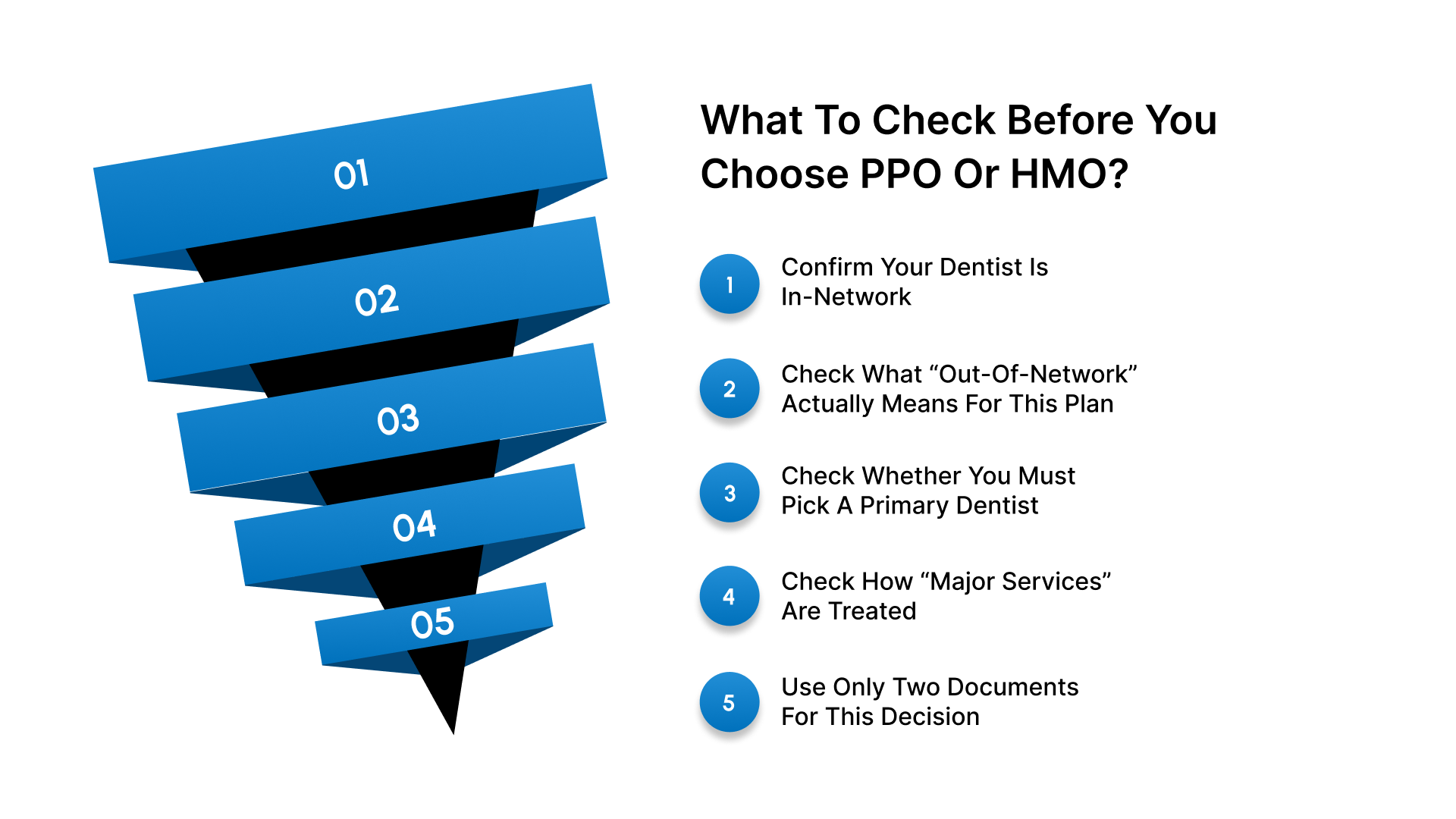
1) Confirm Your Dentist Is In-Network
A clinic saying they “take” a plan does not always mean they are in-network for your specific plan version.
What to do instead:
Check the plan’s official provider directory for your ZIP code.
Search the dentist by name + location (not just the clinic name).
If the directory looks outdated, call the plan and ask them to confirm the network status for that dentist.
2) Check What “Out-Of-Network” Actually Means For This Plan
Out-of-network can mean very different outcomes depending on the plan:
It may be covered partially
It may be covered in limited situations
Or it may not be covered at all (common in many HMO-style plans, and sometimes in dental HMOs)
What you’re checking for is simple:
Does the plan pay anything out of network?
If it does, how does it decide what it pays (allowed amount rules vary)?
Can you still be billed the difference?
3) Check Whether You Must Pick A Primary Dentist, and How Hard It Is To Change
This matters most for DHMO-style dental plans.
Confirm:
Do you have to select (or get assigned) a primary dentist before care is covered?
If you need to switch later, what’s the process, and how fast does it update?
4) Check How “Major Services” Are Treated
You’re not trying to memorize coverage rules here. You’re checking whether major work tends to be:
more restricted,
more rule-driven,
or more dependent on network rules.
Look for how the plan describes major services in general terms (you’ll usually see categories like preventive/basic/major). If the plan documents are vague, that’s a signal to pause and clarify.
5) Use Only Two Documents For This Decision
People get overwhelmed because they read the wrong stuff.
The two documents that matter most:
Summary of Benefits / Plan Summary (how the plan works)
Provider Directory (who is actually in-network in your area)
If either one doesn’t clearly answer your questions, don’t guess.
If this still feels like a maze or you’re trying to keep costs low and don’t want to risk choosing the wrong network, getting guided plan clarity is usually easier than piecing it together yourself.
TrueCost Group As The Next Step When PPO/HMO Choices Feel Confusing
TrueCost Group supports people who want dental coverage but don’t want to decode plan language on their own. Instead of bouncing between directories and PDFs, you get advisor-led help understanding how dental plan options typically work and what a practical choice looks like for your situation.
Why this helps when the budget is tight:
It reduces guesswork when plan documents feel unclear or inconsistent.
It keeps you from enrolling based on assumptions that can lead to paying cash later.
It helps you move faster, without spending hours comparing random pages.
What you can expect
A clearer sense of which plan type fits your needs.
Cleaner next steps for enrollment, without confusion overload.
Less time wasted trying to “interpret” plan wording on your own.
Reach out on Messenger for a free dental plan options check to explore coverage choices that may fit your budget and timeline.
Conclusion
PPO and HMO are just two ways a plan sets the rules. What matters is how those rules affect your dentist choice, what happens if you go out of network, and how many steps sit between you and an appointment.
If you want to decide quickly, start with the provider directory for your ZIP code and confirm the out-of-network policy in the plan documents. Those two checks prevent most surprises.
And if the details still feel hard to compare, get help before you enroll. A short guided review can save you from choosing a plan that looks fine on paper but leaves you paying more than you expected.
FAQs
Is PPO better than HMO for dental?
Not automatically. PPO can give more dental choices. HMO-style dental plans can be more structured and cost-focused. The right pick depends on whether your dentist is in-network and how strict the plan is about out-of-network.
What is the difference between DPPO and DHMO?
DPPO usually means a larger dentist network and better pricing in-network, with some plans allowing out-of-network under different terms. DHMO usually means you choose an in-network primary dentist and follow tighter network rules. Details vary by plan.
Does “my dentist takes the plan” mean they’re in-network?
Not always. Offices may accept billing for many plans, but that doesn’t confirm in-network status. The plan’s directory (or the plan itself) is the source to trust.
What does out-of-network mean in dental plans?
It means the dentist does not have a contract with the plan. Some plans may pay something, some may pay little, and the way the plan calculates its share can leave you with a larger bill. Always check the plan’s out-of-network rule.
Do HMOs require referrals in dental plans?
Sometimes, but dental plan “extra steps” often show up as primary dentist selection or plan rules about where you can receive care. If referrals matter to you, confirm the plan’s process before enrolling.
Can I switch from HMO to PPO later?
Often, only during an allowed enrollment period, and only if PPO options are available where you live. If flexibility matters, check your switching window and plan availability before you decide.