
Introduction
You're sitting in the dentist's chair when you hear the words: "You're going to need a crown." Immediately, your mind races. What exactly is a crown? Will it hurt? How much will this cost me? If you've just received a crown recommendation, you're not alone — approximately 15 million U.S. adults receive a dental crown each year, and many share the same concerns.
This article covers everything you need to make an informed decision:
- What a dental crown is and why dentists recommend them
- The different types and materials available
- What the procedure actually involves
- Realistic cost expectations
- How dental insurance — or the lack of it — affects what you'll actually pay out of pocket
Whether you're fully insured, underinsured, or paying entirely out of pocket, knowing what crowns cost and what your options are puts you in a much stronger position before you say yes.
Key Takeaways
- A crown is a tooth-shaped cap that covers and protects a damaged tooth down to the gum line
- Dentists recommend crowns for severe decay, cracks, post-root canal protection, or large failing fillings
- Material options include zirconia, porcelain, porcelain-fused-to-metal, and gold/metal alloys
- Costs range from $500 to $3,000 per tooth depending on material and location
- Most dental insurance covers 50% of crown costs after your deductible and annual maximum are met
What Is a Dental Crown?
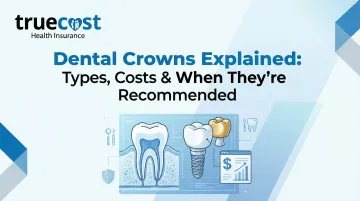
A dental crown — often called a "cap" — is a custom-made, tooth-shaped restoration that fits entirely over a damaged or weakened tooth from the gum line up. It restores the tooth's original shape, size, and function while protecting it from further damage.
How Crowns Work
The crown encases the visible portion of your natural tooth — the tooth itself stays underneath. Once cemented permanently in place, the crown becomes the new outer surface, allowing normal biting and chewing while shielding the weakened structure below.
Crown vs. Filling: What's the Difference?
A filling repairs a small, localized area of decay within the tooth. A crown covers the entire visible tooth and is used when damage is too extensive for a filling to hold.
Clinical guidelines point to a crown when a tooth has lost 50% or more of its structure, or when cavity width exceeds 2mm — thresholds where fillings have high failure rates.
When Would a Dentist Recommend a Dental Crown?
Dentists recommend crowns when a tooth's structure is too compromised to be restored with a simple filling. Here are the most common scenarios:
Severe Tooth Decay
When decay has destroyed too much of the tooth for a filling or inlay to reliably restore it, a crown covers and reinforces the remaining tooth structure. This prevents further breakdown and distributes chewing forces evenly across the entire tooth surface, rather than concentrating stress on weakened areas.
Cracked, Fractured, or Broken Tooth
Even cracks that aren't yet painful can worsen under normal chewing pressure and eventually split the tooth completely. A crown holds the cracked tooth together, acting like a splint that prevents the crack from deepening. Clinical studies show that endodontically treated cracked teeth restored with crowns have survival rates between 92% and 96%, while those without permanent crown restoration have a 12.5-fold increased risk of failure.
After a Root Canal Treatment
Root canal therapy removes infected pulp, saving the tooth from extraction, but leaves the tooth dehydrated and brittle. Research confirms that placing a crown on a root-canal-treated tooth increases its survival odds approximately four-fold compared to fillings alone. This is why crowns are standard after root canal treatment on back molars — these teeth endure the highest chewing forces and are most prone to fracture without full coverage protection.
Large or Failing Fillings
When an existing filling is very large, cracked, or failing, the remaining tooth structure may not be strong enough to support another filling. Each time a tooth is drilled and refilled, more natural structure is lost.
At some point, there simply isn't enough healthy tooth left to anchor a new filling — and a crown becomes the only reliable option to restore full function.
Cosmetic or Restorative Purposes
Crowns improve the appearance of severely discolored, misshapen, or worn-down teeth that can't be adequately treated with whitening or bonding. They're also used to anchor dental bridges or cap dental implants — restoring both the look and function of a missing tooth in a single fixed prosthetic.
Types of Dental Crowns and Their Materials
Crown material is chosen based on the tooth's location (front vs. back), your aesthetic preferences, budget, and whether you have metal sensitivities. Each material offers distinct trade-offs between durability, appearance, and cost.
| Material Type | Aesthetics | Durability | Best For |
|---|---|---|---|
| Zirconia | High (tooth-colored) | Very high (fracture resistant) | Front & back teeth |
| All-Ceramic/Porcelain | Excellent (most natural) | Moderate (prone to chipping) | Front teeth |
| Porcelain-Fused-to-Metal (PFM) | Good (tooth-colored) | High (metal core strength) | Front & back teeth |
| Metal/Gold | Low (metallic color) | Excellent (longest lasting) | Back molars |

Zirconia Crowns
Zirconia crowns have rapidly gained popularity because they combine strength with natural tooth color. Zirconia now accounts for approximately 32% of material choices in some dental networks, rivaling traditional porcelain-fused-to-metal crowns. They're highly durable, resistant to chipping, biocompatible, and require less tooth reduction during preparation than PFM crowns. This versatility makes them a strong fit for both front and back teeth, though they sit at a mid-to-high price point.
Porcelain or All-Ceramic Crowns
These provide the most natural-looking results, closely matching the color and translucency of natural teeth. They're best suited for front teeth where aesthetics matter most. The downside: they're more prone to chipping than metal-based options under heavy chewing forces. They're also the preferred choice for patients with metal sensitivities or allergies.
Porcelain-Fused-to-Metal (PFM) Crowns
PFM crowns offer a compromise: a metal base provides structural strength while the outer porcelain layer is color-matched to surrounding teeth. They work well for both front and back teeth and have a long track record of durability. The main aesthetic drawback is a thin dark metal line that may become visible at the gum line as gums naturally recede over time.
Metal Crowns (Gold and Base Metal Alloys)
For back molars that take the brunt of chewing, metal crowns — gold alloys or non-precious metals — are hard to beat. They rarely chip or break, withstand heavy biting forces better than ceramic options, and require the least amount of natural tooth removal during preparation. Their metallic appearance limits them to out-of-sight back molars, but patients who prioritize longevity over aesthetics often choose gold for exactly that reason.
What Happens During a Dental Crown Procedure?
Most dental crown procedures follow a standard two-visit workflow over two to three weeks, though same-day CAD/CAM technology is making single-visit crowns increasingly available. Local anesthesia is used throughout, so most patients feel little to no discomfort.
Visit 1 — Tooth Preparation and Impression
What happens:
- Your dentist takes X-rays to assess the tooth's root and surrounding bone
- The tooth is numbed with local anesthesia
- The dentist reshapes the tooth by filing down the top and sides to create room for the crown
- Any decayed portions are removed during this shaping process
- If the tooth is severely damaged, a "core buildup" using filling material may be needed to provide adequate support for the crown
- An impression (putty mold or digital scan) is taken to guide the lab in fabricating your custom crown
- A temporary crown is placed to protect the tooth while the permanent crown is made
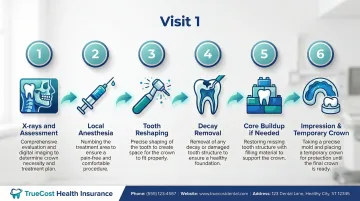
Timeline: The permanent crown typically takes 2-3 weeks to fabricate in a dental laboratory.
Visit 2 — Permanent Crown Placement
What happens:
- The temporary crown is removed
- The permanent crown is checked for fit, color match, and bite alignment
- Minor adjustments may be made chairside if needed
- The crown is cemented into place with dental adhesive
Mild sensitivity to hot or cold and gum soreness are normal for a few days. Over-the-counter pain relievers like ibuprofen are usually enough, and symptoms resolve on their own.
What to Avoid After Getting a Crown
Protect your crown — especially a temporary one — by steering clear of:
- Hard foods like ice, hard nuts, popcorn hulls, and hard candy, which can crack or dislodge a crown
- Sticky or chewy foods like taffy, caramels, and gummy candies, which can pull a crown loose
- Nighttime grinding (bruxism) — ask your dentist about a custom night guard; zirconia crowns show a 92% survival rate in bruxism patients who use occlusal guards, versus 80% in those who don't
How Much Do Dental Crowns Cost — And Does Insurance Help?
For uninsured Americans, the cost of a crown represents a significant financial barrier. Prices vary substantially by material, geographic location, and individual dentist.
Estimated Cost Ranges (2023-2025)
The following ranges reflect typical out-of-network or uninsured pricing:
| Crown Material | Estimated Cost Per Tooth |
|---|---|
| All-Porcelain/Ceramic | $800 – $3,000 |
| Zirconia | $950 – $1,600 |
| Porcelain-Fused-to-Metal (PFM) | $500 – $1,500 |
| Metal/Gold | $500 – $2,500 |
Note: Costs in major metropolitan areas may be higher than these national averages.
How Dental Insurance Typically Handles Crowns
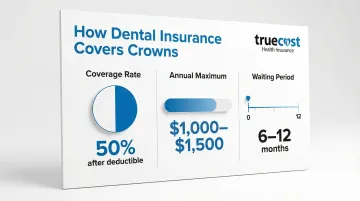
Most dental insurance plans classify crowns as "major restorative" procedures, which affects how — and how much — your plan pays. Here's what to expect:
- 50% coverage for major procedures is standard, applied after your deductible is met
- Annual maximums typically cap at $1,000–$1,500; beyond that, you pay 100% out of pocket
- Waiting periods of 6–12 months are common on new policies before crown coverage kicks in
Coverage Options for Uninsured Americans
Approximately 27% of adults — about 72 million Americans — lack dental insurance, nearly three times the rate of those without medical insurance. Among the 11.1% of working-age adults who are completely uninsured, the out-of-pocket cost of a crown is often prohibitive. A few coverage pathways are worth knowing.
ACA Marketplace plans: Dental coverage is not required for adult plans under the Affordable Care Act, but stand-alone dental plans are available through the Marketplace. For children 18 and under, pediatric dental is a mandatory essential benefit.
Medicare Advantage plans: Traditional Medicare does not cover routine dental work. By contrast, 98% of Medicare Advantage plans offered dental benefits in 2026, and over 90% include some coverage for dental services — including major restorative work like crowns, typically subject to a $1,000–$2,000 annual cap.
If you're uninsured and unsure which of these pathways applies to you, TrueCost Group's licensed advisors can walk through your eligibility for ACA Marketplace and Medicare Advantage plans — including those with dental benefits — at no cost. Call 1-888-788-8285 or request a text-based quote with no spam calls.
How to Care for a Dental Crown and How Long It Lasts
The average lifespan of a dental crown is 10 to 15 years, though crowns can last 20 to 30 years or longer with proper maintenance. Longevity depends on the material chosen, the quality of fit, your oral hygiene habits, and whether you grind your teeth.
Daily Care Guidelines
Most crown care overlaps with standard oral hygiene — but a few details matter more than usual:
- Brush twice daily with a soft-bristled toothbrush and fluoride toothpaste, focusing on the crown margin where it meets the gum line
- Floss daily — the crown can't decay, but the tooth underneath can; slide the floss out rather than snapping it up
- Rinse with antibacterial mouthwash to reduce plaque buildup around the margin
- Keep up with professional cleanings so your dentist can spot problems before they worsen
Contact your dentist promptly if:
- The crown feels loose or wiggles
- You notice a chip or crack
- You experience persistent pain around the crown
- You notice a bad taste or odor near the crown (which could indicate decay underneath)
Common Causes of Crown Failure
Even well-placed crowns can fail. The three most common reasons:
- Decay at the margin — plaque buildup at the crown's edge allows cavities to form in the tooth underneath; this is the leading cause of crown failure
- Chipping or fracture — porcelain can crack under heavy bite force, especially in patients with untreated bruxism
- Cement washout — the bonding cement can erode over time, causing the crown to loosen or fall off entirely
Frequently Asked Questions
Why would a tooth need a dental crown?
Crowns are recommended for teeth with severe decay, cracks, or fractures, after root canal treatment, when a large filling is failing, or for cosmetic restoration of severely discolored or misshapen teeth.
What happens to your natural tooth when you get a dental crown?
The dentist files down the enamel so the crown fits over the tooth, which remains permanently underneath. The underlying tooth is still alive and can develop decay if oral hygiene is neglected.
Is it painful to get a dental crown?
The procedure itself is performed under local anesthesia and should not be painful. Patients may experience mild soreness or temperature sensitivity for a few days after placement, which typically resolves on its own and can be managed with over-the-counter pain relievers.
How long does a dental crown last?
Crowns typically last 10 to 15 years on average, and potentially 20 to 30 years or longer with proper care. Longevity depends on the material chosen, the quality of fit, and oral hygiene habits like brushing, flossing, and avoiding hard foods.
What is the difference between a crown and a filling?
A filling repairs a small, localized area of decay within the tooth, while a crown covers the entire visible portion of the tooth from the gum line up. Crowns are used when the damage or decay is too extensive for a filling to adequately support the tooth structure.
Does dental insurance cover dental crowns?
Most dental insurance plans cover crowns at 50% after the deductible, subject to annual maximums (often $1,000–$1,500). Those without coverage may qualify for ACA Marketplace or Medicare Advantage plans that include dental benefits. TrueCost Group can help determine your options. Call 1-888-788-8285 for a free consultation.